

What Is an Institutional Investor? (And Why Retail Investors Track Them)
An institutional investor is a large organization that invests pooled money on behalf of other people — think pension funds, mutual funds, insurance companies, and hedge funds. Because they trade in enormous size with professional research behind them, institutional investors are often called Wall Street’s “smart money,” and their moves are watched closely by everyone from analysts to individual retail investors.
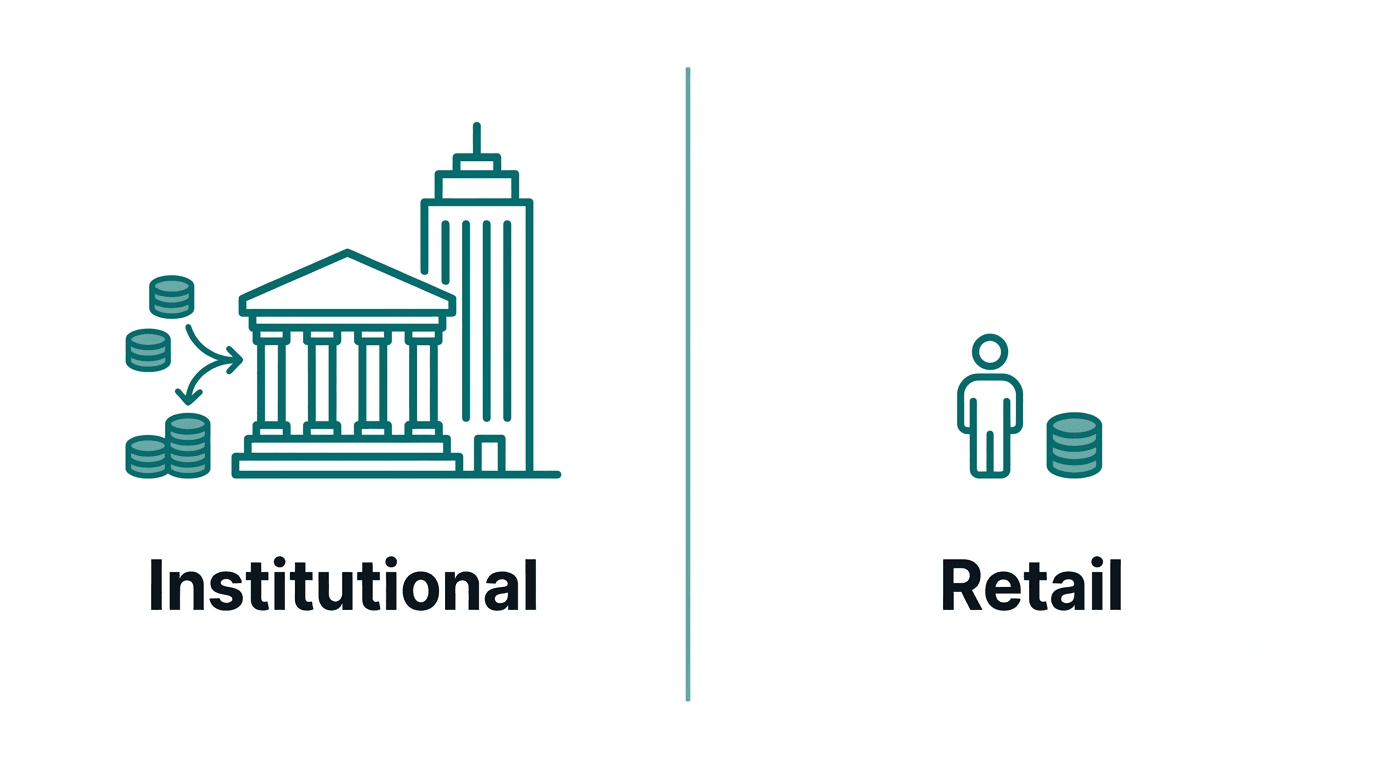
What is an institutional investor?
An institutional investor is an entity — not an individual — that pools capital from many sources and invests it in securities, real estate, and other assets. The money isn’t the manager’s own; it belongs to pensioners, policyholders, university endowments, or fund shareholders. That creates a fiduciary duty: institutions are legally bound to act in their beneficiaries’ best interests.
Scale is the defining trait. The world’s largest asset managers oversee tens of trillions of dollars in assets under management (AUM), and institutions account for the majority of daily stock-trading volume. When one buys or sells, it often does so in block trades large enough to move a stock’s price — a market impact an individual could never have.
Types of institutional investors
“Institutional investor” is an umbrella term. The main types are:
- Pension funds — invest to pay retirees; among the largest institutions of all.
- Mutual funds & ETFs — pool retail money into professionally managed, regulated portfolios.
- Insurance companies — invest premiums to cover future claims.
- Hedge funds — private, flexible funds for accredited investors that can use leverage and short selling.
- Endowments & foundations — manage the long-term capital of universities and charities.
- Sovereign wealth funds — state-owned funds investing national reserves.
- Banks & family offices — round out the group.
Institutional vs. retail investors
The clearest way to understand institutional investors is to compare them with retail investors — individuals investing their own money for their own goals. The gaps are wide:
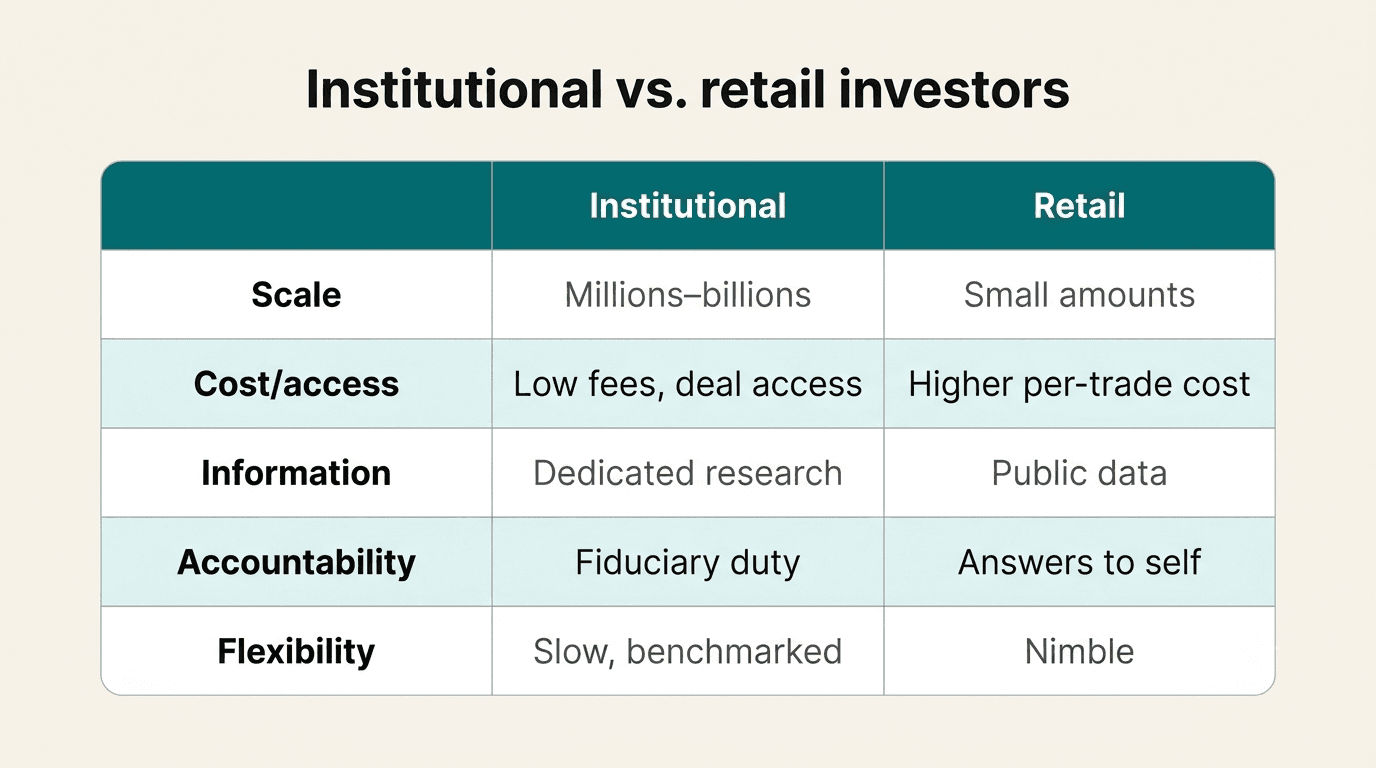
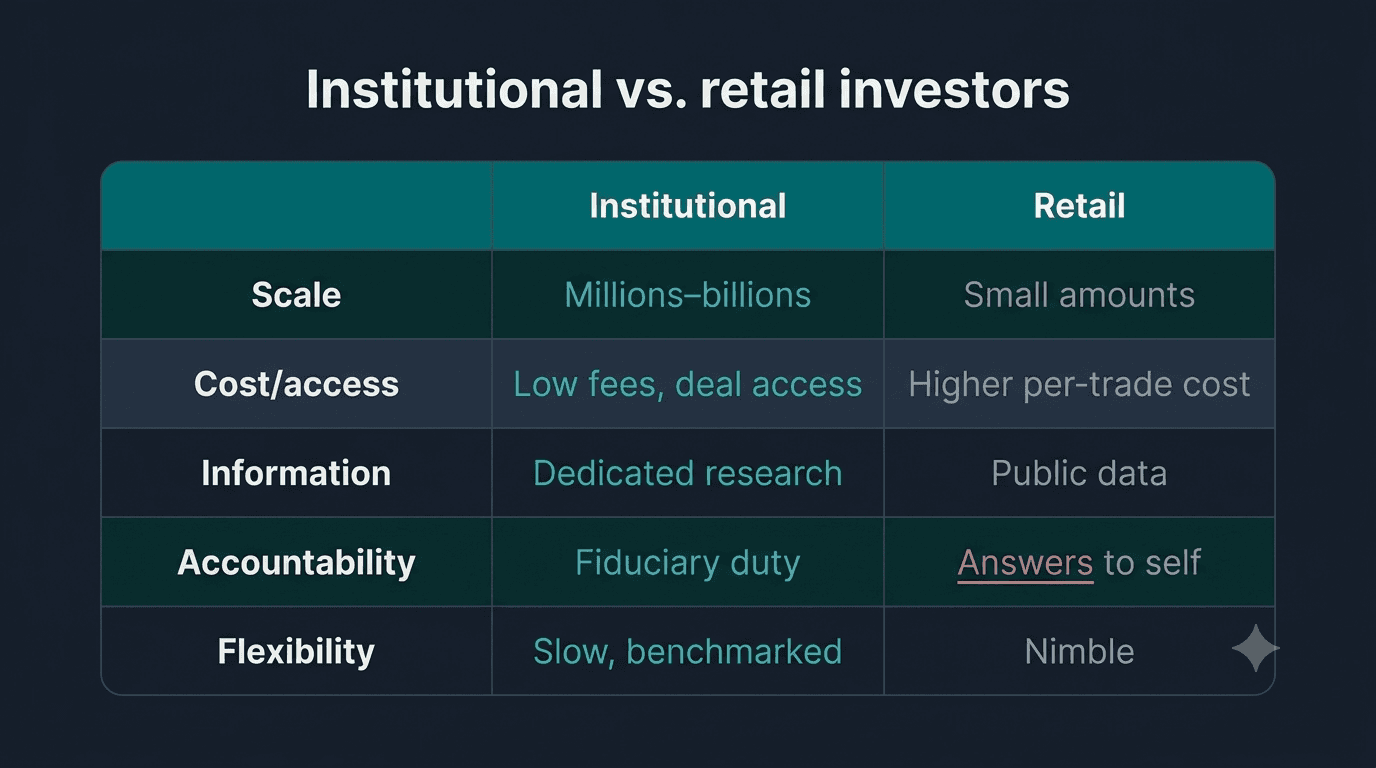
- Scale. Institutions move millions or billions; retail investors trade in far smaller amounts.
- Cost & access. Institutions get lower trading costs and access to deals and asset classes closed to individuals.
- Information. They employ dedicated research teams and buy data most individuals never see.
- Accountability. Institutions answer to beneficiaries under a fiduciary duty; retail investors answer only to themselves.
Retail investors aren’t without advantages, though. They can move in and out instantly, hold positions too small for a giant fund to bother with, and ignore the quarterly benchmark pressure that institutions live under.
Why institutional investors are called “smart money”
The smart money nickname reflects those advantages: professional expertise, deep research, and superior data. When a respected institution builds a large position, many assume it knows something the crowd doesn’t. That’s why institutional buying and selling can move markets and shape sentiment.
But “smart money” is a description of resources, not a promise of results. Many institutions fail to beat a simple index fund, and following one blindly can lead you straight into a losing trade. It’s a signal to research, not a signal to copy.
Why retail investors track institutional investors
Here’s the twist that tilts the field back toward individuals: U.S. law forces large institutions to reveal their stock holdings. Any institutional investor managing over $100 million in U.S. equities must file a 13F filing with the SEC every quarter, listing what it owns. Four times a year, the smart money has to show its work — for free.
Retail investors use those disclosures to generate ideas, study how a skilled manager builds a thesis, and see which stocks are gaining institutional support. The two big caveats: the data carries a 45-day lag, and a 13F only shows long U.S. equity positions — not shorts, hedges, or timing. Treat it as research, not a trade signal. None of this is financial advice.
How to follow institutional investors
Every 13F is public on the SEC’s EDGAR system, but the raw filings are tedious to read. FundFollower parses them into clean, searchable portfolios so you can see holdings, position sizes, and quarter-over-quarter changes at a glance.
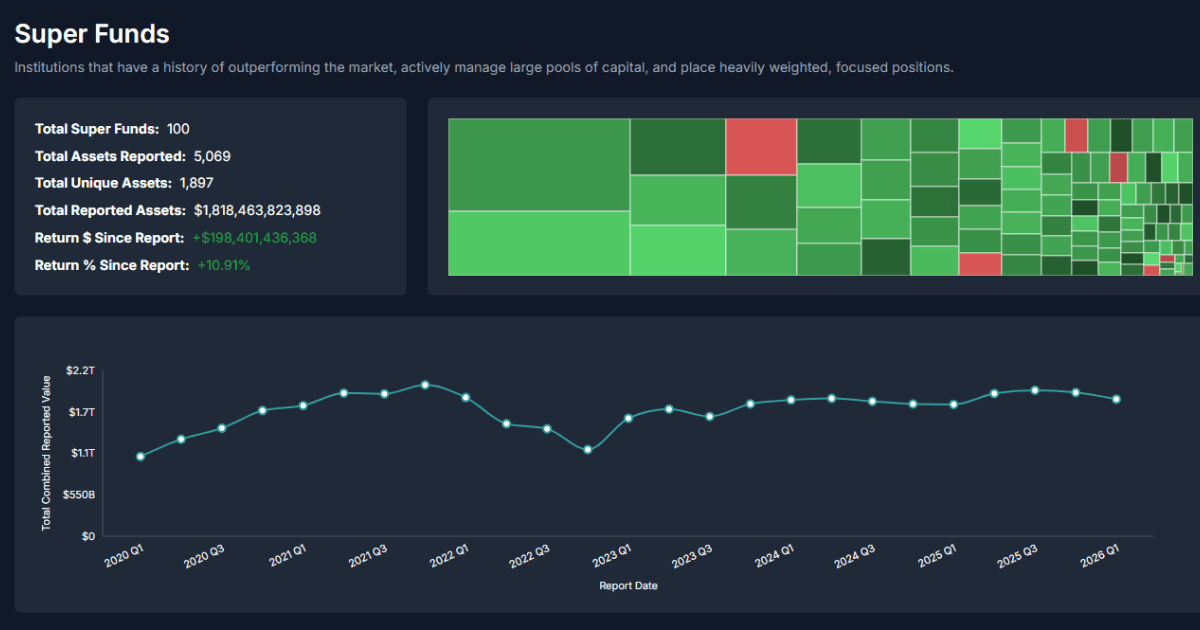
Browse the full institutions directory — from Berkshire Hathaway to Oaktree — see which stocks the most institutions hold on the most-held assets page, or watch new buys and sells on the activity feed.
Frequently asked questions
What types of institutional investors are there?
The main types are pension funds, mutual funds, insurance companies, hedge funds, endowments and foundations, sovereign wealth funds, banks, and family offices. They differ in who they invest for and how aggressively they invest, but all pool large sums and trade at scale.
What is the difference between an institutional and a retail investor?
An institutional investor is an organization investing pooled money on behalf of others — with big budgets, professional research teams, lower per-trade costs, and a fiduciary duty to its beneficiaries. A retail investor is an individual investing their own money in much smaller amounts. Institutions move markets; retail investors generally don't.
Why are institutional investors called 'smart money'?
Because they're professionals with dedicated research, better data, and deep resources, their trades are seen as more informed than the average individual's — hence 'smart money.' It's a nickname, not a guarantee: plenty of institutions underperform, so the label describes their advantages, not their results.
Can retail investors beat institutional investors?
Sometimes. Retail investors are nimbler, can hold tiny positions institutions can't touch, and face no redemption pressure or benchmark. But they lack the research budgets and information access institutions have. Tracking institutional holdings via 13F filings is one way individuals borrow some of that edge — with the caveat that the data is 45 days old.
How can I see what institutional investors own?
Institutions managing over $100 million in U.S. stocks must file a quarterly 13F with the SEC listing their equity holdings. Those filings are public, so you can track any large institution's positions — with a 45-day lag — on aggregators like FundFollower.
Want to see 13F filings without the 45-day headache of raw EDGAR?
FundFollower turns every filing into a live, searchable portfolio. Browse institutional investors →