

What Is a 13F Filing? A Plain-English Guide
A 13F filing is a quarterly report that large institutional investment managers must file with the U.S. Securities and Exchange Commission (SEC) disclosing their U.S. stock holdings. If a firm manages at least $100 million in qualifying securities, it has to reveal what it owned at the end of each quarter — giving the public a window into how hedge funds and other big investors are positioned.
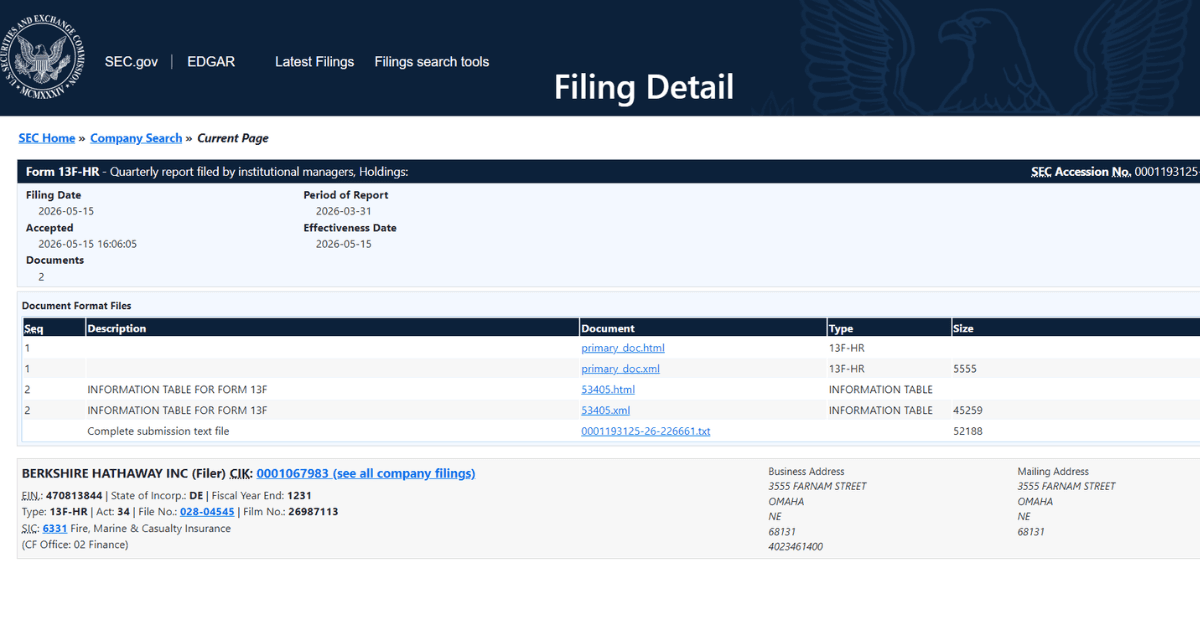
What is a 13F filing?
Form 13F was created by Section 13(f) of the Securities Exchange Act, which Congress added in 1975 to make institutional holdings public. The idea was simple: the biggest players move markets, so their equity positions should not be a secret. Every quarter, a qualifying manager lists each U.S.-listed security it holds — the company name, the ticker, the number of shares, and the market value as of the last day of the quarter.
Those disclosures are what let a retail investor see that, say, Berkshire Hathaway added to a position or that a well-known fund started a new one. It is the raw material behind almost every “what the smart money is buying” headline.
Who has to file a 13F?
The rule applies to institutional investment managers that exercise investment discretion over $100 million or more in 13(f) securities — a list the SEC publishes that covers most U.S.-listed stocks, ETFs, and certain convertible notes and options. The label “manager” is broad. It includes:
- Hedge funds and other private funds
- Mutual funds and asset managers
- Pension funds and endowments
- Banks, insurance companies, and registered investment advisers
Once a firm crosses the $100 million threshold, filing is mandatory — missing or late filings can trigger SEC enforcement. You can browse thousands of these managers on the institutions directory.
When are 13Fs filed? The 45-day deadline
A 13F is due 45 days after the end of each quarter. In practice that means the typical filing dates are on or around February 14, May 15, August 14, and November 14. The SEC treats these deadlines as firm and does not grant routine extensions. Every filing flows into the SEC’s EDGAR (Electronic Data Gathering, Analysis, and Retrieval) system, where it becomes public the moment it is accepted.
That 45-day window is the single most important thing to understand about 13F data, and it leads straight to the filing’s biggest limitation.
What a 13F reveals — and what it hides
A 13F is a snapshot of long U.S. equity positions on one specific day — the last day of the quarter. That makes it useful, but structurally incomplete. Here is the split:
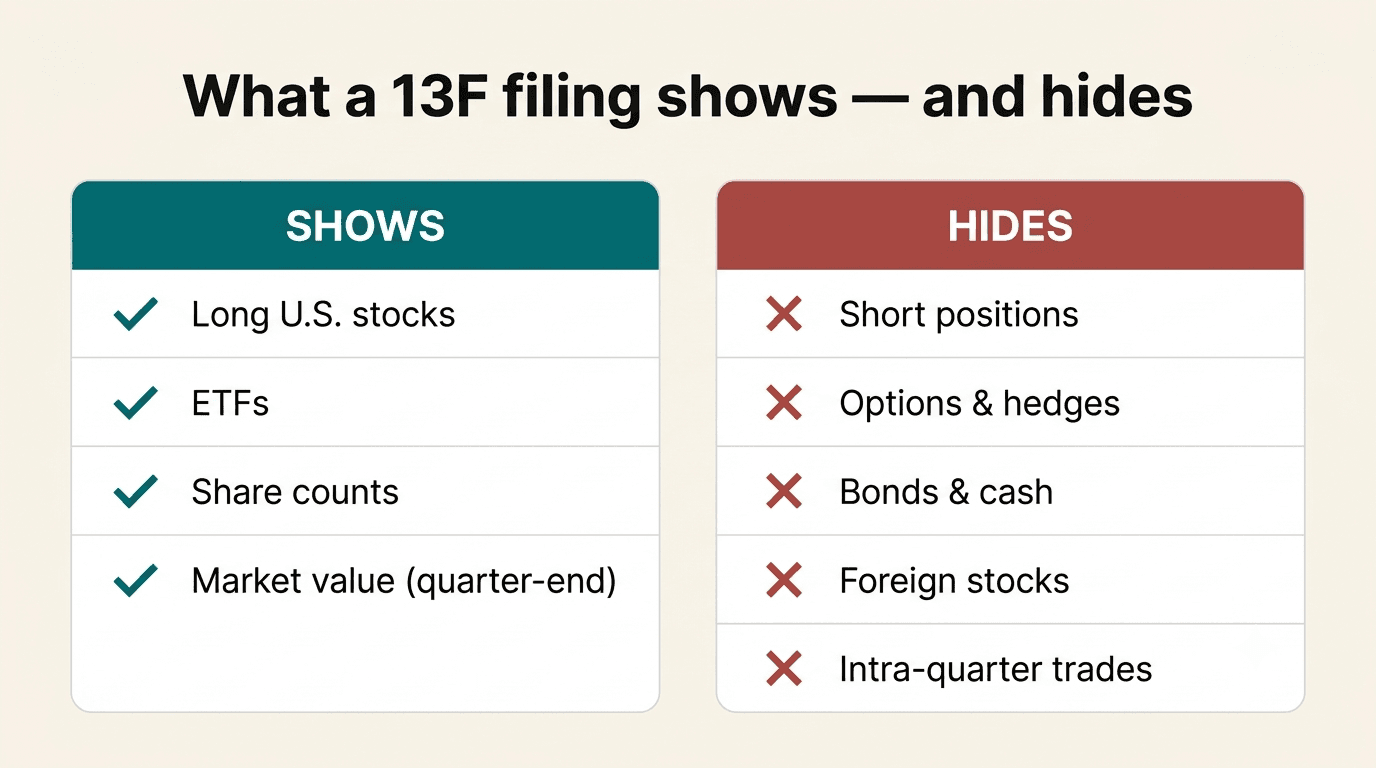
What it shows: long positions in U.S.-listed stocks and ETFs, plus certain options and convertible securities, with the share count and dollar value for each.
What it hides:
- Short positions. A 13F never shows what a fund is betting against, so a long you see could be fully hedged by a short you don’t.
- Timing. Because of the 45-day lag, a manager may have already exited a position by the time you read about it.
- Intra-quarter trades. It is a single-day snapshot, so a stock bought and sold within the quarter never appears.
- Everything non-equity. Bonds, cash, commodities, currencies, and most foreign-listed shares are excluded.
One more caveat worth stating plainly: any “return” you calculate from 13F data is quarter-relative and gross, not an annualised performance figure — and none of this is financial advice.
Why investors track 13F filings
Despite the limitations, 13Fs are one of the few free, standardised windows into how professional money is allocated. Investors use them to spot which stocks are gaining or losing institutional support, to study how a respected manager builds a thesis over several quarters, and to generate research ideas worth their own due diligence. Watching which names show up across many funds at once — visible on the most-held assets view — can reveal where the crowd is leaning.
The key is to treat a filing as a starting point, not a verdict. A single quarter’s snapshot from one fund tells you far less than the trend across many filings over time.
How to read a 13F filing
The source of truth is always EDGAR: search a manager’s name, open its latest 13F-HR, and you’ll find the holdings table. Reading the raw XML is workable but tedious, which is why most people use an aggregator that parses EDGAR for them.
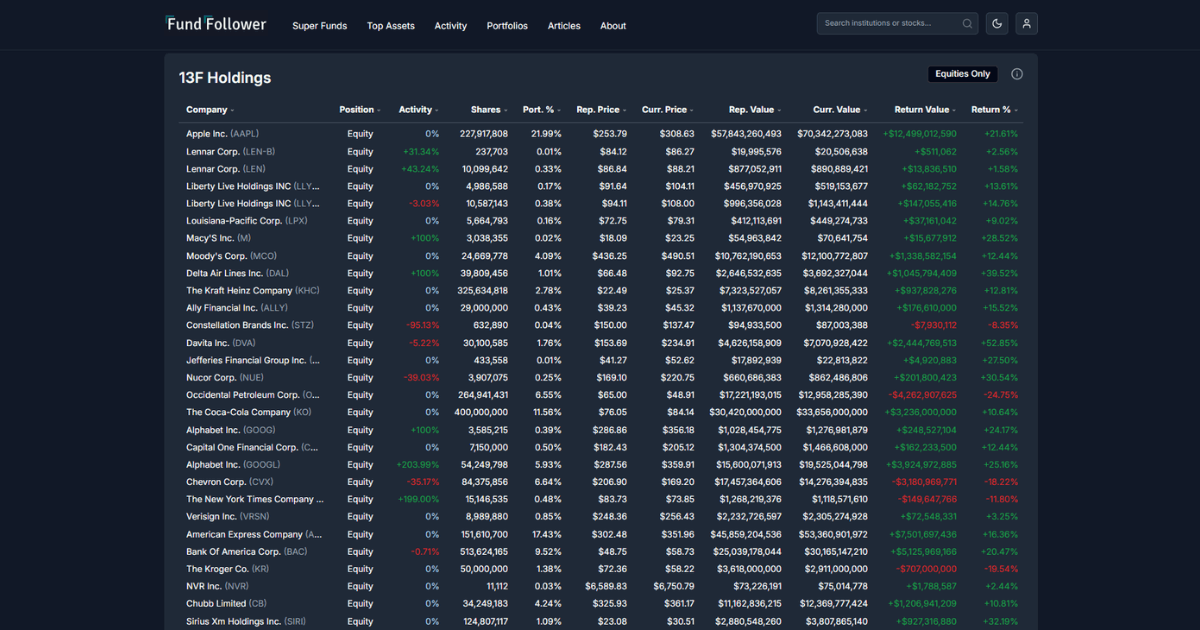
FundFollower reads every 13F from EDGAR and presents it as a clean portfolio: current holdings, position sizes, and what changed since last quarter. You can follow the Berkshire Hathaway portfolio, watch new buys and sells roll in on the latest activity feed, and keep the 45-day lag front of mind as you do.
Frequently asked questions
Who has to file a 13F?
Any institutional investment manager that exercises investment discretion over $100 million or more in 13(f) securities (mostly U.S.-listed stocks and ETFs) must file. That includes hedge funds, mutual funds, pension funds, banks, insurance companies, and registered investment advisers.
How often are 13Fs filed and when are they due?
Form 13F is filed quarterly. The deadline is 45 days after the end of each calendar quarter, which usually lands around February 14, May 15, August 14, and November 14.
What does a 13F filing show and not show?
A 13F shows a manager's long U.S. equity positions — the stocks, ETFs, and certain convertible securities they held on the last day of the quarter, with share counts and market values. It does not show short positions, options used as hedges, bonds, cash, commodities, or most non-U.S. holdings.
Are 13F filings public and where can I find them?
Yes. All 13Fs are public and filed through the SEC's EDGAR system, so anyone can read them for free. Aggregators like FundFollower parse EDGAR and present the same data as searchable portfolios with quarter-over-quarter changes.
Can you use 13F filings to copy hedge funds?
You can see what a fund owned, but blindly copying is risky. Because of the 45-day lag, the fund may have already sold by the time you read the filing, and a 13F omits the shorts and hedges that give the position its real risk profile. Treat 13Fs as research leads, not trade signals. This is not financial advice.
Want to see 13F filings without the 45-day headache of raw EDGAR?
FundFollower turns every filing into a live, searchable portfolio. Browse institutional investors →