

What Is a Hedge Fund? How They Work, Fees & Strategies
A hedge fund is a private investment fund that pools money from wealthy individuals and institutions and uses flexible, often aggressive strategies — leverage, short selling, and derivatives — to chase returns in any market. In exchange for that flexibility, hedge funds charge high fees, restrict who can invest, and lock up investors’ money in ways ordinary mutual funds never do.
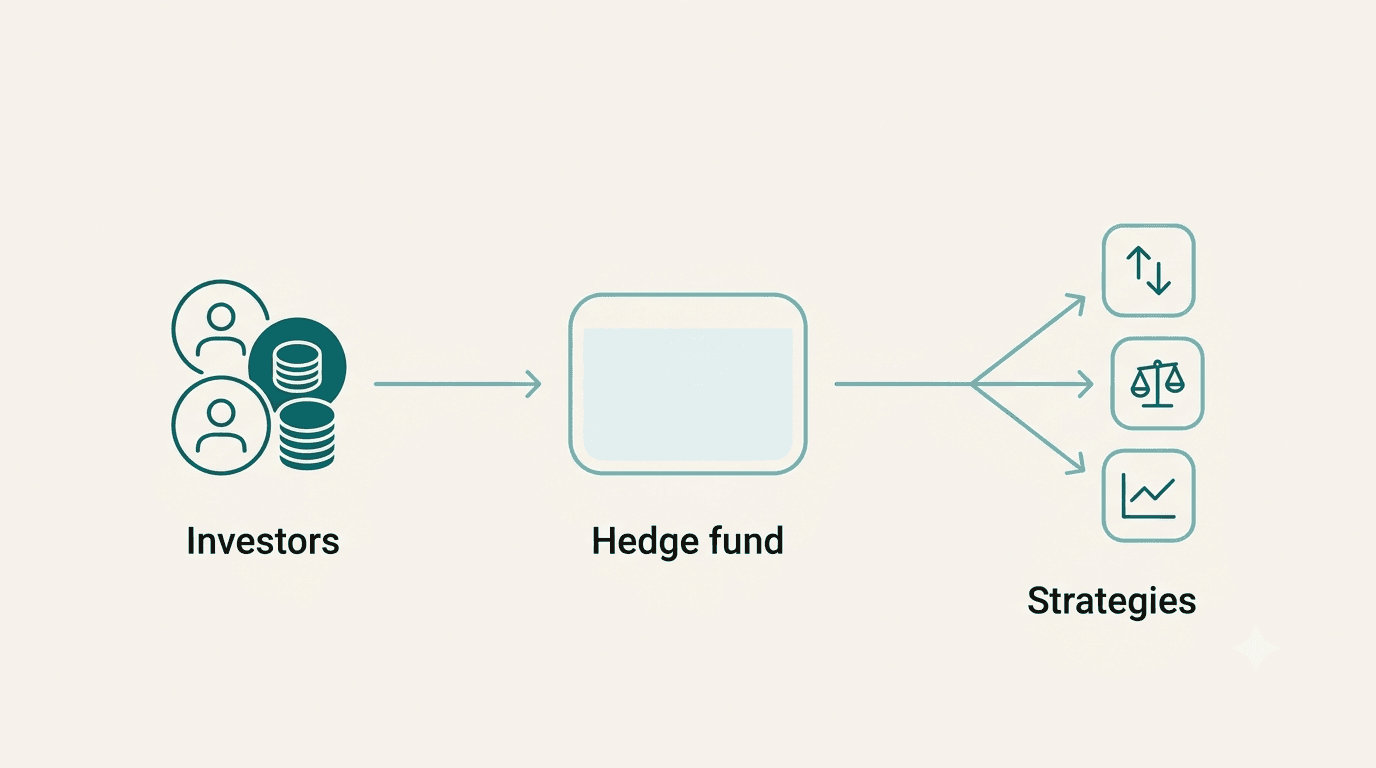
What is a hedge fund?
The name comes from “hedging” — offsetting one bet with another to limit risk — but modern hedge funds do far more than hedge. They are pooled investment vehicles that aim for absolute return: a positive result whether markets rise or fall. Because they’re sold privately to a small group of sophisticated investors, they avoid most of the rules that constrain registered funds, which is exactly what lets them use tools a mutual fund can’t.
That freedom cuts both ways. A hedge fund can post spectacular gains or blow up — Long-Term Capital Management famously did the latter in 1998 — so the category spans everything from steady, low-volatility strategies to highly leveraged bets.
How do hedge funds work?
Most hedge funds are structured as limited partnerships. The management company acts as the general partner (GP) that runs the strategy, while investors come in as limited partners (LPs) who supply the capital. A prime broker handles trade execution, lending, and leverage, and an administrator strikes the fund’s net asset value (NAV).
A few features define how the money behaves:
- Leverage. Funds borrow to amplify positions, magnifying both gains and losses.
- Short selling. They can profit when a stock falls, not just when it rises.
- Lock-ups and redemptions. Investors often can’t withdraw for a year or more, and even then only quarterly.
- Wide mandate. Beyond stocks, funds can trade bonds, currencies, commodities, and derivatives.
Hedge fund fees: the “2 and 20” model
The classic fee structure is “2 and 20”: a 2% management fee charged annually on assets under management (AUM), plus a 20% performance fee on the profits the fund generates. The management fee keeps the lights on; the performance fee is where managers get rich when they perform.
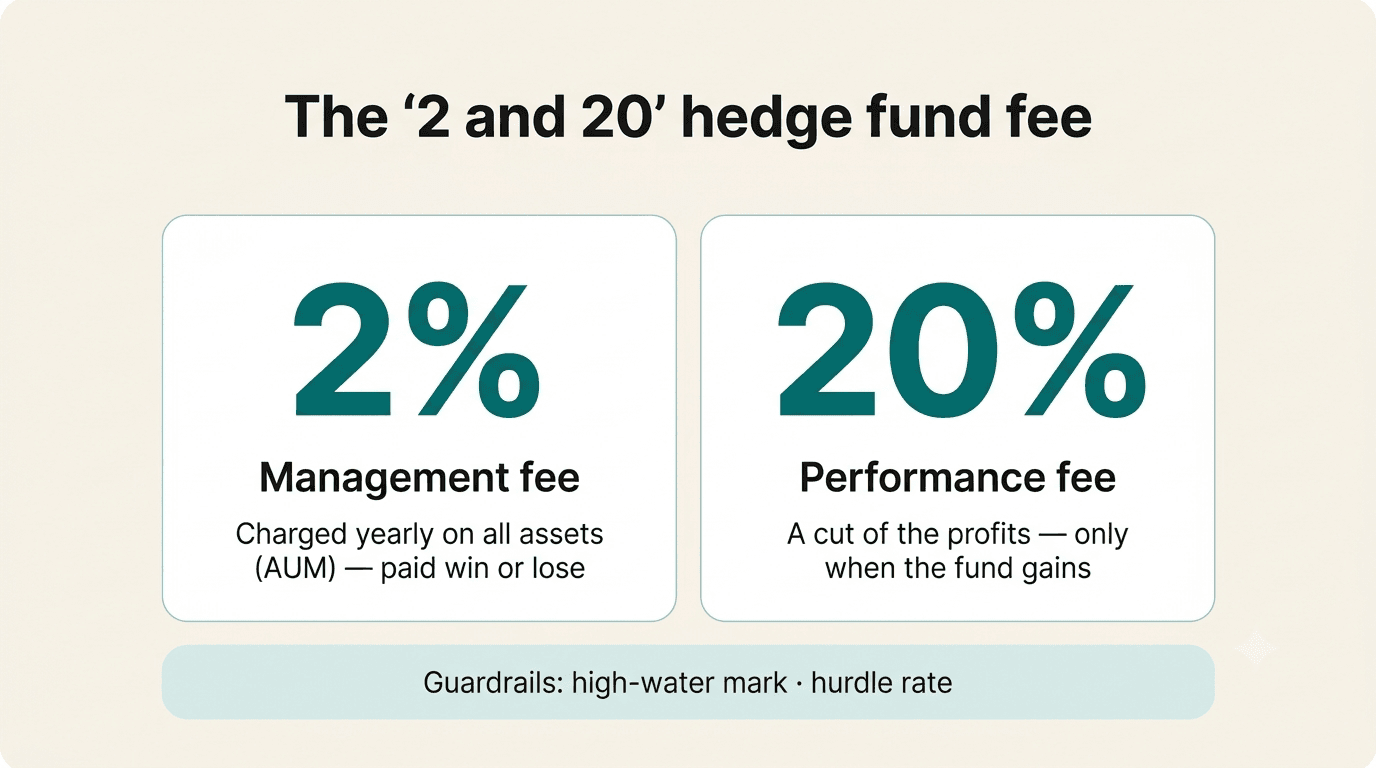
Two guardrails usually protect investors from paying performance fees they haven’t earned:
- High-water mark. The manager only earns performance fees on new profits — losses must be recouped first.
- Hurdle rate. Some funds only take a cut of returns above a set threshold (say 8%), so the fee applies to outperformance, not the whole gain.
“2 and 20” is now more benchmark than reality. Competition has pushed average fees closer to 1.3% and 16%, and newer managers often offer discounts to win early capital. The high fees only make sense if the fund delivers returns you can’t get cheaply from an index fund — which many don’t.
Common hedge fund strategies
“Hedge fund” describes a structure, not a single playbook. The main strategy families are:
- Long/short equity. Buy stocks expected to rise and short those expected to fall — the original hedge fund approach.
- Global macro. Bet on big-picture moves in interest rates, currencies, and economies. Bridgewater Associates is the best-known example.
- Event-driven. Trade around mergers, bankruptcies, and restructurings (including merger arbitrage).
- Relative value / arbitrage. Exploit small price gaps between related securities, often with heavy leverage.
- Quantitative. Use models and algorithms to trade at scale — think Renaissance Technologies or Citadel.
Who can invest in a hedge fund?
Hedge funds aren’t open to everyone. U.S. rules generally restrict them to accredited investors (about $1 million in net worth excluding your home, or $200,000+ in annual income) and qualified purchasers. Minimums commonly run from $100,000 to $1 million, and your capital is typically locked up for a year or more.
That’s the core contrast with a mutual fund, which any retail investor can buy for a few hundred dollars, with daily liquidity and far lower fees. Hedge funds trade that accessibility for flexibility, potential outperformance, and returns that ideally don’t move in lockstep with the stock market.
How to see what hedge funds are buying
You may not be able to invest in a top fund, but you can still watch what it owns. Managers with over $100 million in U.S. equities must disclose their stock holdings every quarter in a 13F filing with the SEC. Those filings are public — with a 45-day lag — so you can follow the equity positions of hedge funds like Atreides Management or Situational Awareness.
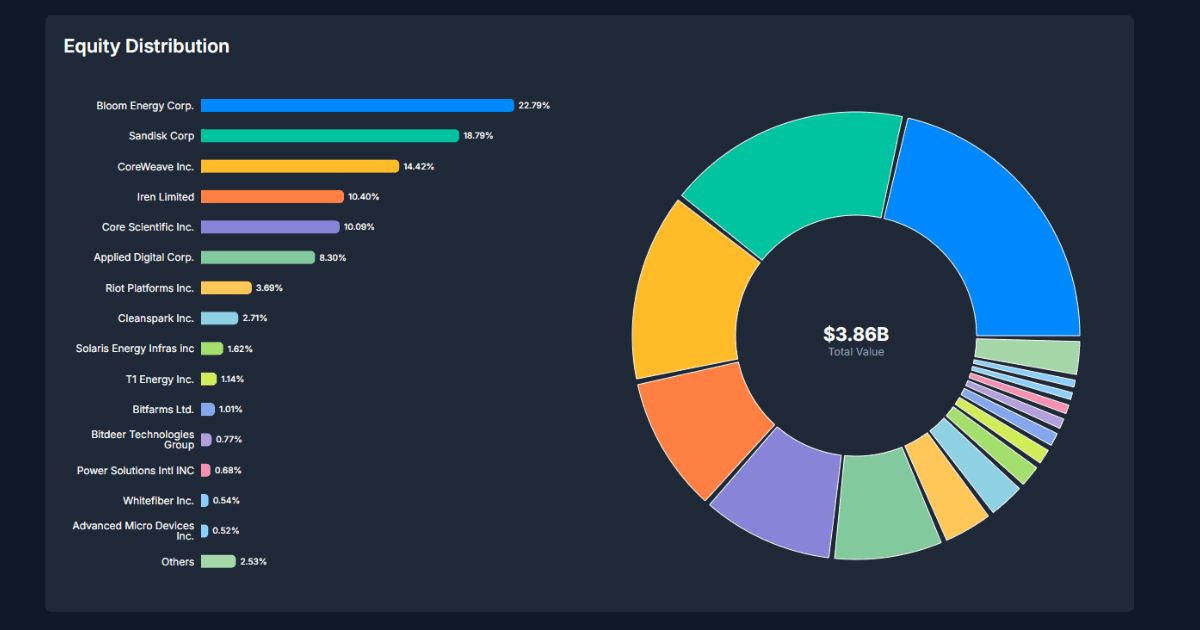
FundFollower parses those filings into clean, searchable portfolios so you can see which stocks the biggest managers are buying and selling each quarter. Browse the full institutions directory or see which names show up most across funds on the most-held assets page.
Frequently asked questions
How is a hedge fund different from a mutual fund?
A mutual fund is a registered, retail product open to anyone, usually long-only, with daily liquidity and low fees. A hedge fund is a private fund open only to accredited investors and institutions, can use leverage, short selling, and derivatives, locks up your money, and charges performance fees. Hedge funds trade flexibility and potential returns for higher risk, higher cost, and less access.
Who can invest in a hedge fund and how much do you need?
In the U.S. you generally must be an accredited investor (roughly $1M net worth excluding your home, or $200K+ income) or a qualified purchaser. Minimum investments commonly run from $100,000 to $1 million or more, and your money is often locked up for a year or longer.
What does '2 and 20' mean?
It's the classic hedge fund fee structure: a 2% annual management fee on assets under management plus a 20% performance fee on profits. Many funds now charge less (closer to 1.3% and 16%), and performance fees are usually gated by a high-water mark and sometimes a hurdle rate.
Are hedge funds worth the fees?
It depends entirely on the manager. Fees this high only make sense if the fund delivers returns, or diversification, that you can't get cheaply elsewhere — and after fees many funds fail to beat a simple index. The appeal is uncorrelated 'absolute' returns and access to strategies retail products can't run, not guaranteed outperformance. This is not financial advice.
How can I see what hedge funds are buying?
Large managers must disclose their U.S. stock holdings every quarter in a 13F filing with the SEC. Those filings are public, so you can track a fund's equity positions — with a 45-day lag — on aggregators like FundFollower, even if you can't invest in the fund itself.
Want to see 13F filings without the 45-day headache of raw EDGAR?
FundFollower turns every filing into a live, searchable portfolio. Browse institutional investors →